

There’s no denying it: amber has fascinated people for hundreds of years
Several hundred years ago, people were fascinated by the extraordinary and inexplicable properties of golden pebbles found on the coast and in coastal forests. These stones would burn if thrown into a fire, giving off a pleasant scent of pine and aromatic smoke. Another magical quality was that when these stones were rubbed, they could attract other small objects.
The insides of these stones seemed to hide small plants or insects that appeared to have found their way inside by magic as well.
That was enough to pique the curiosity of early humans, who viewed this unusual gemstone with admiration and respect. It is therefore not surprising that humans began to attribute magical powers to amber.
Excerpt from *The Great Book of Amber* by Elzbieta Mierzwinska

large piece of amber before cutting and polishing for the manufacture of a piece of jewellery
A Brief History of Baltic Amber
Amber is one of the few substances on Earth that we consider a gemstone but that is not of mineral origin. Diamonds, jet (both derived from coal), and amber are the only gemstones of plant origin. The value of any gemstone is directly linked to its rarity. Like diamonds, amber is the result of nature’s work over thousands of years. This is yet another reason why it is used to create magnificent jewelry.

Set of cut and uncut gemstones : Diamond, amber, ruby, emerald, topaz, jet, sapphire…
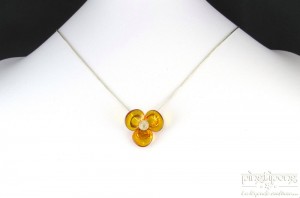
Amber touches the soul, enchants the eye, warms the heart, and sparks the imagination of the scientific community. Amber, an organic resin, has the unique and singular ability to encapsulate and preserve the organic matter it encounters, much like a fly trapped in honey. Baltic amber is approximately 40–60 million years old and was considered a gemstone by many ancient cultures, prized for both its protective and decorative qualities.
Not long ago, in the West, the movie *Jurassic Park* sparked a great deal of interest in this gemstone. However, amber has long captivated human hearts and minds—in fact, amber has even been a key asset for entire economies.
Inside the amber, plants and insects—along with their DNA molecules, the basic code of life—have been preserved. That is why amber is often considered “a window into the past.”

Baltic amber with a trapped insect, here a scorpion
The most common inclusions are plant fragments, including oak leaf remnants, pollen, spores, leaves, twigs, and—above all—the most well-known inclusions of all: insects. At least 214 plant species have been identified through morphological analysis of amber. The scientific study of amber has provided a wealth of valuable data about the ancient world—scientific data that, were it not for amber’s exceptional preservative qualities, would have been lost forever.
“I pick up a piece of Baltic amber because of its natural beauty and its connection to the living world. Since I have no scientific background, I have no idea what this tiny creature inside is called—or rather, these creatures, since there are so many of them.”
“I know it’s lovely, and I hope to incorporate it into a piece of jewelry that I’ll have made someday. The piece of amber is in my private collection. It’s truly wonderful to hold in the palm of your hand a reflection of the world as it was before the first human was born.”
“Andzia,” a book I bought in Gdańsk, Poland, in the mid-90s.
The Origins of Baltic Amber
About 45 million years ago, the territory of Northern and Central Europe—now known as Fennoscandia—was covered by a thick “amber forest” stretching from the Norwegian coast to the Caspian Sea, before the continental block split apart to form what we know today as Europe.
Amber is not, as is commonly believed, pine sap; rather, it is the result of the fossilization of plant resins caused by injury or a drastic climate change. Experts have recently identified three species of trees closely related to those that produced these resins. They are:

The amber resulting from complex chemical transformations of the resin has been transported to the Baltic Sea by waterways
~ Agathis (araucaria, Australia)
~ Cedrus atlantis (cedar, Atlas cedar, North Africa)
~ Pseudolarix wheri (larch, Canada)
Scientists at the Polish Science Museum are speculating about the reddish hues found in cherry amber; they believe this is due to resin from deciduous trees, such as plum or cherry trees.
The common name for these trees, which produce amber, is Pinus succinifera. It is believed that during a period of climate upheaval, these trees produced an unusually large amount of resin. Over thousands of years, this resin underwent countless physical and chemical changes, ultimately resulting in amber (succinite). Amber resins were first carried to the sea by freshwater rivers in the mountainous regions of the Amber Forest; even entire trunks, severely damaged by temperature fluctuations, were transported to the sea in this way.

Resin falling from a tree, it is the original component of amber.
It is known that the inclusions found in amber from the subtropical forest also contained the following tree species: palms, cypresses, magnolias, rhododendrons, tea shrubs, oaks, maples, horse chestnuts, mistletoe, and cinnamon trees, as well as various types of heather, mosses, lichens, and molds. This forest must have been incredibly beautiful. To scientists, Pinus succinifera was a tree similar to today’s sequoias. “Succinum” is the Latin name for resin or sap, also meaning juice—later it came to mean amber.
The quality of amber is determined by the density of succinic acid it contains. Baltic amber contains the highest proportion of succinic acid, making it the most valuable type of amber.
The Amber Road
The ancient amber trade routes connected nations that were very far apart. Since it is a luxury item found only in a few, widely scattered geographic areas, amber was one of the few commodities worth transporting over such long distances. From the Baltic Sea to the Elbe River, following the Danube, one can trace the ancient amber trade routes.
Amber was one of the earliest commodities and has been traded for centuries. Amber pendants dating back to the Paleolithic era (12,000 B.C.) have been found. Archaeologists have uncovered the remains of amber jewelry workshops dating back to the Neolithic period. At the same time, amber caches were also found embedded beneath the foundations of houses, likely to bring good luck to the occupants.

Cliffs, amber has been transported from sea to sea by rivers since prehistoric times.
The ancient Amber Road initially ran through the north and along river routes, from Jutland to the Elbe, from Western Pomerania to the Oder, through Bohemia, across Pomerania to the Vistula, and from the Samland Peninsula to the Black Sea coast. Then, by land, it passed through the Brenner Pass into Italy, heading toward the heart of the Roman Empire.
During the period from the 1st to the 4th century B.C., it was the Celts who reestablished very ancient trade routes—which had existed long before their time and had previously been dominated by other peoples, notably the Phoenicians. Amber artifacts from various periods have been found in the tombs of Mycenae in Greece, as well as in Babylonia and Egypt—in Tutankhamun’s tomb—and even in Brighton, United Kingdom, where a particularly famous amber cup was discovered in a burial mound.
In the 1st century A.D., Rome was on its way to becoming the undisputed center of the amber industry.
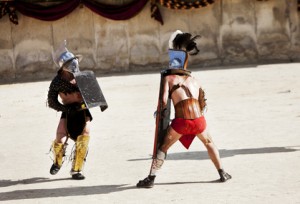
Gladiatorial combat, amber was widely used in Roman arenas
The Romans used amber in a number of different objects, including coins. They apparently valued amber more highly than the blond-haired Baltic slaves—the amber gatherers—whom they brought back to Rome along with the amber. Amber was mentioned by Homer in the Odyssey, and Pliny the Elder wrote that a small piece of carved amber was worth more than a healthy slave.
We learn from *The Great Book of Amber* that, during Nero’s reign, an expedition was sent to the Baltic Coast to procure amber. It brought back such a large quantity that the gladiatorial combat scenes were engraved exclusively on amber. Even the net used to restrain wild animals and cover the arena had a piece of amber in each knot. ‘
-Pliny, *Natural History*, XXXVII
The Middle Ages were a period of great social upheaval and migration. Before the 1100s, Gdańsk served as the main center for amber production. The introduction of Christianity led to the widespread use of the cross as a motif in amber objects.
After the Teutonic Knights returned from the Crusades in the second half of the 12th century CE, they became the undisputed rulers of Prussia, the Baltic amber deposits, and the production of amber objects—primarily religious items such as paternoster beads (Christian rosaries).
These Knights ruled with an iron fist. Anyone caught in possession of a piece of amber that was not part of a rosary was severely punished and, often, hanged. Lithographs typically depict the amber fisherman alongside the gallows, a grim warning to anyone who might attempt to take amber for themselves outside the church.
During my first trip through Poland, I saw one of the great castles of the Teutonic Knights for the first time through the train window: Malbork Castle. I thought I was dreaming… as I looked at those walls, those courtyards, those moats, those turrets with their banners fluttering in the wind,…
I was fortunate enough to return to Malbork Castle a few years later. The collection of amber objects includes more than 2,000 cataloged pieces and is eclectic—ranging from ancient artifacts created by early human craftsmen to contemporary works by artisans who work with amber today.

Marlbork Castle, castle of the Teutonic knights masters of amber in the Middle Ages
Even today, amber continues to cross the seas; in particular, it has been exported to China for millennia. The Chinese use it, among other things, in traditional Chinese medicine to fight infections, calm the nerves, and so on… whereas in Western countries, it is mainly used in jewelry making to create amber jewelry. Its warm color pairs particularly well with the cool tone of silver. But it is also used for its scent when burned.

See our entire collection of amber jewelry from our Pingtipong store here

